Fitness article
Goblet Squat Exercise
The goblet squat is a front-loaded squat performed while holding a dumbbell or kettlebell close to the chest. It trains the legs and trunk while the positi
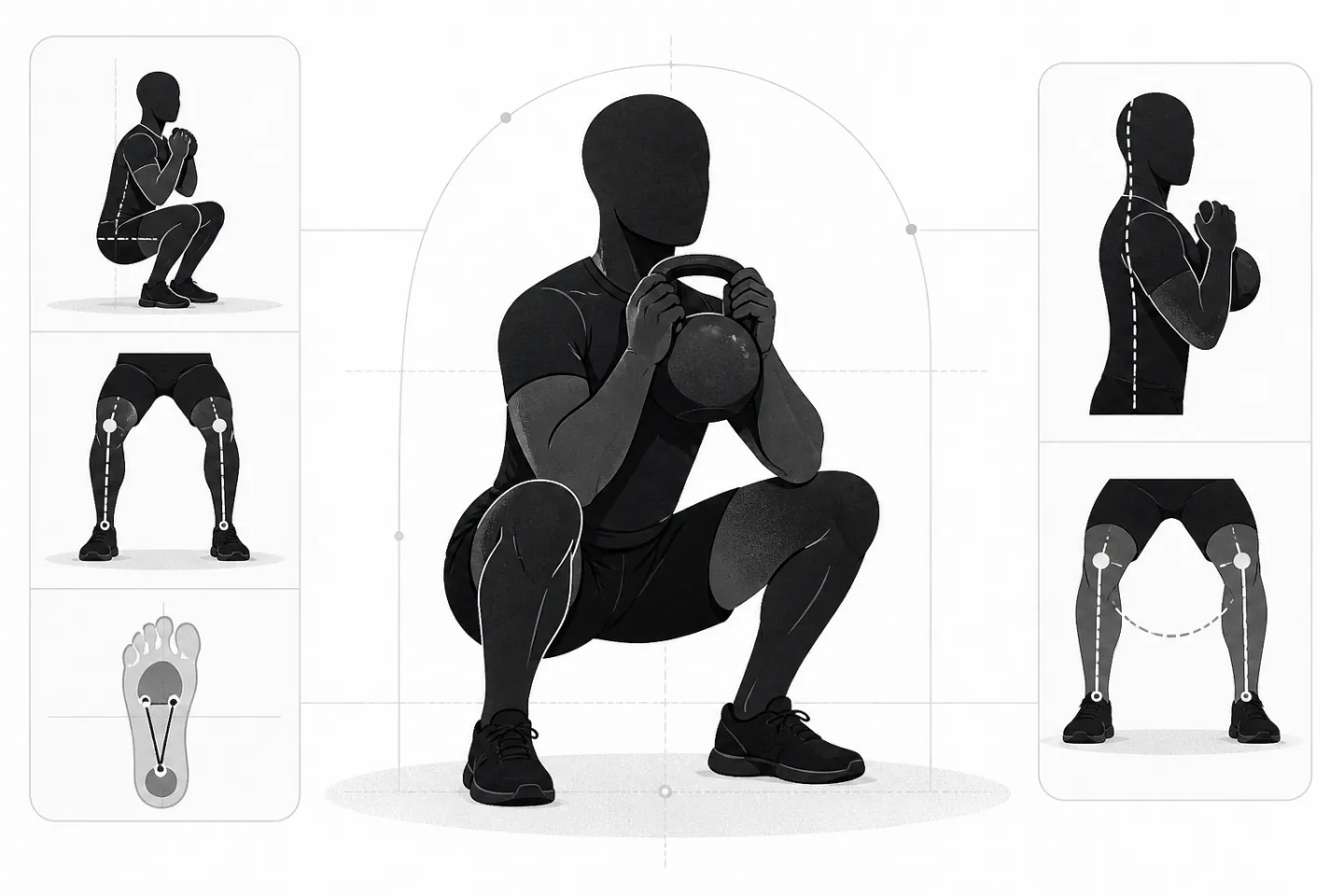
The goblet squat is a front-loaded squat performed while holding a dumbbell or kettlebell close to the chest. It trains the legs and trunk while the position of the weight provides a useful counterbalance. This often makes the movement easier to learn than a squat with a load behind the body.
The exercise suits beginners learning the squat pattern and experienced trainees who want controlled lower-body work without a barbell. It can build strength, reinforce balance and help identify limits in ankle, hip or trunk control. The aim is not to reach the deepest possible position. It is to move through the greatest depth you can control without pain, heel lift or a marked change in spinal position.
What the goblet squat works
The quadriceps straighten the knees as you stand, while the gluteal muscles and adductors help extend the hips. The calves and muscles around the feet stabilise the ankles. Holding the weight at chest height also requires the abdominals, back, shoulders and arms to keep the load steady.
Because the weight sits in front of the torso, it encourages you to stay upright and sit between the hips. That does not guarantee good form, but it gives immediate feedback: if the load drifts forward, the upper body usually follows. A clear goblet squat technique guide can help you compare the main positions before practising.
Equipment and starting position
Use a dumbbell held vertically by one end or a kettlebell held by its side handles. Keep the implement close enough that you can support it without bending the wrists sharply. Train on a firm, level surface with enough clear space to set the weight down safely.
Choose a load that lets you complete every planned repetition at an even pace. Start lighter than you think necessary when learning. The weight is too heavy if it pulls away from your chest, makes you rush the descent or prevents you from standing without the knees collapsing inward.
Set your stance
Place the feet roughly shoulder-width apart. Turn the toes slightly outward if that allows the knees and hips to move comfortably. Individual stance width and toe angle vary, so use alignment rather than a fixed angle as the test: the knees should travel in the same general direction as the toes.
Keep three points of each foot in contact with the floor: the heel, the base of the big toe and the base of the little toe. Hold the weight at the upper chest, point the elbows down and look ahead or slightly towards the floor. Gently brace the abdomen while keeping the ribs above the pelvis.
How to perform a goblet squat
- Stand tall in your chosen stance and secure the weight against your chest.
- Take a controlled breath and brace your trunk before beginning the repetition.
- Bend the knees and hips together, lowering your body between your feet rather than pushing the hips far behind you.
- Keep the whole foot planted and guide the knees in line with the toes.
- Stop at the deepest position you can reach while keeping the load close, the feet stable and the lower back controlled.
- Press the floor away and extend the hips and knees together to stand.
- Finish tall without leaning back, then reset your breath and balance before the next repetition.
Use a steady descent rather than dropping into the bottom. A brief pause can help you check balance, but do not relax under the load. Exhale as you pass the hardest part of the ascent, then breathe normally at the top. A goblet squat form guide offers another reference for the basic sequence.
Useful position checks
- Load: close to the chest, with the wrists comfortable and elbows pointing down.
- Feet: stable from heel to forefoot, without rolling onto the inner or outer edges.
- Knees: moving with the toes rather than collapsing towards each other.
- Torso: braced and controlled, without the chest folding towards the floor.
- Depth: limited by control and comfort, not by a target that forces the heels or pelvis out of position.
Common problems and practical corrections
The heels lift
Heel lift may reflect a stance that is too narrow, limited ankle movement or an attempt to squat below your current controlled range. Try turning the toes out a little, widening the feet slightly or stopping at a higher depth. A small, stable heel wedge can make the exercise more accessible, but it should not wobble or compress under load.
The knees move inward
Reduce the load and slow the repetition. Check that pressure remains across the whole foot rather than shifting to the inner edge. Guide each knee in the direction of its corresponding toes as you descend and stand. If the problem remains even with no weight, use a supported version while practising the movement.
The torso folds forward
First bring the weight closer to the chest. If that does not help, lighten it and reduce the depth. Folding can also occur when the stance does not suit your hip movement or when fatigue has reduced trunk control. End the set once you can no longer keep a consistent torso position.
The lower back rounds at the bottom
A small change in pelvic position is not automatically a problem, but a sudden or uncontrolled rounding suggests that the squat has exceeded your present range. Stop just above that point and build control there. Do not force the elbows between the knees or use them to push the legs apart.
Regressions and progressions
For a simpler version, practise a bodyweight squat while lightly holding a stable support. Use only as much assistance as needed to stay balanced. You can also squat to a sturdy box or bench, using it as a depth marker rather than dropping onto it. Lower under control, touch lightly and stand without rocking.
Once that pattern is comfortable, add a light weight at the chest. The counterbalance may make the movement feel steadier, but the same standards still apply. Guidance on a proper goblet squat can be useful when comparing supported, bodyweight and loaded versions.
Progress only one variable at a time. You might add a small amount of weight, perform another repetition, add a set, slow the lowering phase or pause briefly at the bottom. Changing several variables together makes it harder to tell which one caused a loss of form.
The goblet position eventually limits how much weight you can hold comfortably. That is not a reason to let the load drift forward or to struggle through awkward lifts from the floor. When leg strength exceeds the practical loading limit, keep goblet squats as technique or moderate-load work and choose another squat variation for heavier training.
Sets, repetitions and session placement
For technique practice, begin with two or three sets of six to ten controlled repetitions. Stop each set while you could still complete a few sound repetitions. Rest long enough for breathing and balance to return before starting again.
For general strength or muscle-building work, three or four sets can be appropriate, using a resistance that keeps the movement consistent from the first repetition to the last. Lower repetition sets usually permit a heavier load, while moderate repetition sets provide more time under tension. Neither approach is useful if fatigue changes the squat into a different movement.
Place demanding goblet squats near the start of a lower-body session, after a general warm-up and any movement preparation you need. A light set can also serve as part of a warm-up before another squat pattern. Avoid turning warm-up repetitions into tiring work that reduces the quality of the main exercise.
Increase the difficulty only after all planned sets look alike. A practical progression is to reach the top of your chosen repetition range with steady form, then use the next manageable load and return to the lower end of the range. If the available weight jump is too large, add control through a slower descent or a short pause instead.
Safety and when to stop
Muscular effort and a rising breathing rate are expected during a challenging set. Sharp, catching or increasing pain is not. Stop if pain appears in the knees, hips, ankles, back or groin, or if you cannot set the weight down safely. Persistent pain, pain that changes the way you walk or symptoms that return whenever you squat warrant advice from a qualified health professional.
Stop immediately if you experience chest pain, dizziness, unusual shortness of breath, numbness, tingling or sudden weakness. People returning after surgery or injury, or managing a condition that affects balance or exercise tolerance, should seek individual guidance before adding load.
Form also sets a clear stopping point. End the set when the heels repeatedly lift, the knees collapse, the load moves away from the chest or the descent becomes uncontrolled. Reducing the weight, range or repetition target is a useful adjustment, not a failed session.