Fitness article
Forearm and Grip Workouts: A Simple Strength Progression
Forearm workouts can be simple. A short carry asks your hands to hold a weight while you walk; a supported wrist extension asks the muscles along the…
Forearm workouts can be simple. A short carry asks your hands to hold a weight while you walk; a supported wrist extension asks the muscles along the back of your forearm to move a light weight under control. Together, they give you two distinct tasks to practise and an easy way to notice progress. You need a pair of manageable dumbbells, one lighter dumbbell, a stable surface for supporting your forearm, and a little space to walk.
The aim is to make each session repeatable. Start with a load you can control, record what you did, and change one small detail only when the movements still feel steady. The American College of Sports Medicine’s resistance training guidance places regular participation ahead of a complicated plan. These two movements can be a modest addition to broader strength training, which should still attend to the major muscle groups.
Two movements, two different jobs
Grip carries and wrist exercises are often grouped together, but they are easier to learn when treated separately. During a farmer carry, your fingers hold the handles and your wrists stay relatively quiet while your whole body moves. During wrist extension, your forearm rests on a support and your wrist moves through a small, deliberate range. The carry tests whether you can maintain a secure hold and upright posture for a chosen distance. The extension gives you a slower task you can watch closely.
Movement one: a light farmer carry
Choose two dumbbells light enough that you can pick them up and walk without leaning, hurrying or feeling that a handle might slip. Clear a short, level path and decide where you will stop before lifting. The American Council on Exercise’s farmer carry instructions describe a firm grip, arms at the sides, a straight back and a predetermined walking distance. Its exercise library labels the carry intermediate; a beginner can make the task more manageable by keeping both the weights and the route modest.
- Place the dumbbells beside your feet. Bend at the hips and knees to take hold of them, then stand without jerking them from the floor.
- Let your arms hang beside you. Keep your wrists in line with your forearms rather than letting the handles pull your hands sharply forward or back.
- Walk at a pace that lets you stay upright and place each foot deliberately. Breathe normally; do not hold your breath to finish the route.
- Stop at your planned point while your grip and posture are still secure. Set the weights down with control.
For a first session, two or three short walks may be enough. A route across a room can serve as a starting point if you can turn safely; a longer route is useful only if you can keep the same control throughout it. Rest until your breathing and grip feel ready before repeating. The working feeling may be a firm demand in your hands and forearms. It should not require you to clamp the handles so hard that your shoulders rise towards your ears or your walking becomes uneven.
Watch what happens near the end of each walk. If one dumbbell swings, a wrist folds, or you have to rush to reach the finish, shorten the route or use lighter weights next time. You can also put the weights down before the planned endpoint. That is useful information for your log, not a failed attempt. Keep the route and the weight consistent while you learn what a repeatable carry feels like.
Movement two: supported wrist extension
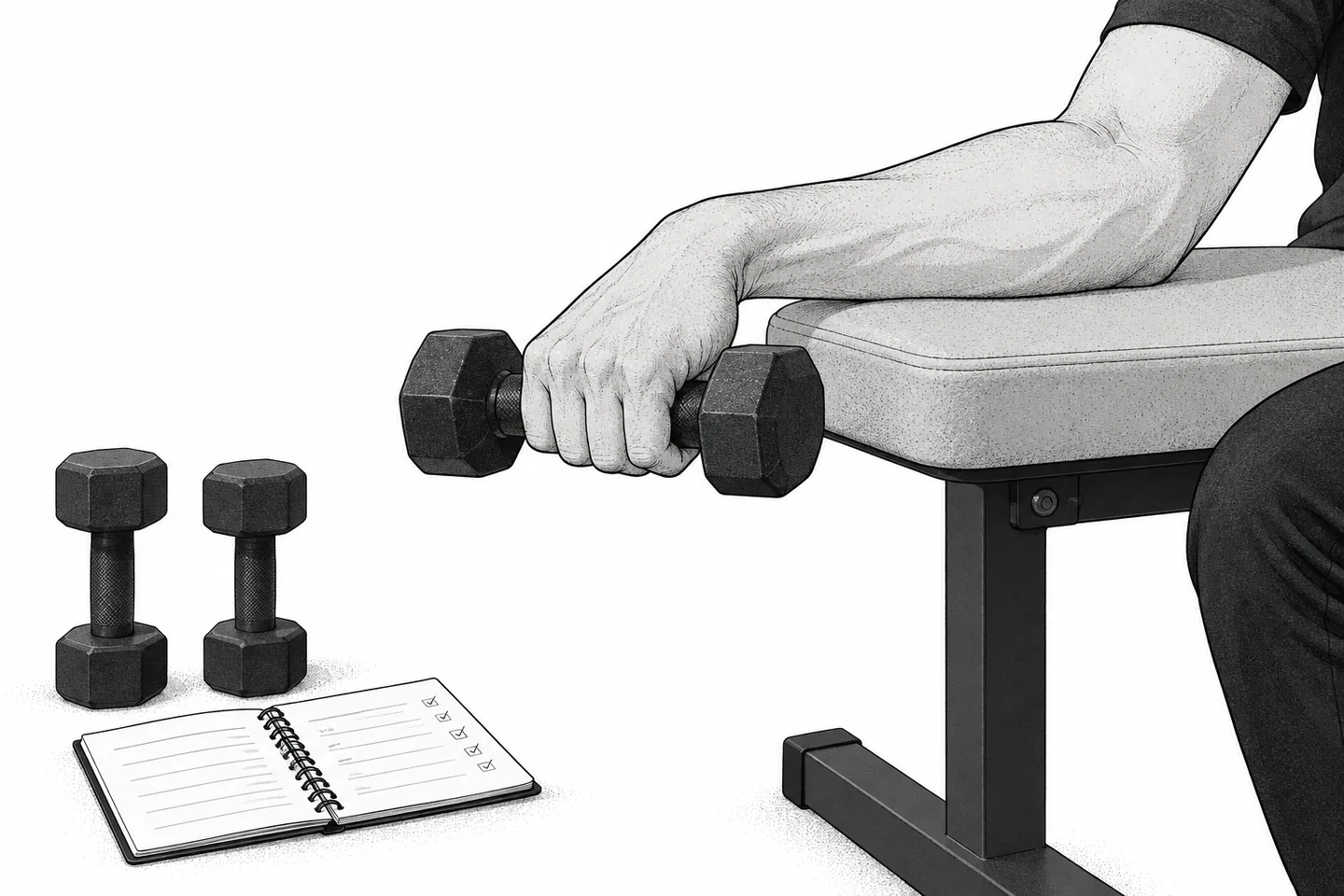
Use a much lighter dumbbell for wrist extension than you used for the carry. Rest one forearm, palm down, on a bench or another stable padded surface, with the hand free to move beyond its edge. Start with the wrist roughly in line with the forearm. The ACE wrist extension guide describes this palm-down position and a controlled lowering and lifting movement while the forearm remains supported.
Hold the dumbbell securely without squeezing harder than needed. Slowly let the hand lower a comfortable amount, then lift it back towards the starting line by moving at the wrist. Keep your forearm resting on the support and your upper body still. Avoid swinging the weight, lifting your elbow or using a large movement to make a heavy dumbbell move. Repeat on the other side with the same light load.
Try a small set of controlled repetitions and stop while you could still perform another with the same pace and position. If you cannot move the dumbbell smoothly, choose a lighter one. If even the lightest available weight feels awkward, practise the motion with an empty hand first. The point is to learn a clear movement, not to reach an arbitrary repetition count.
Put the pair into a short session
Begin with a few minutes of easy movement and a rehearsal of both exercises without demanding loads. Then perform your short carries, resting between walks, followed by supported wrist extensions on each side. You could start with two carries and one set of extensions per arm. Treat that as a trial session, not a minimum you must complete. If the carry has already tired your hands enough to make the extension clumsy, rest longer or do fewer carries.
Leave room for recovery before repeating the pair. A day between sessions is a practical starting point, especially if your work, sport or other training already asks a lot of your hands. Notice how you feel later that day and at the next session. If you are still unusually sore or cannot reproduce the movement comfortably, keep the next session lighter. More work is useful only when you can recover from it and perform it well again.
Progress one detail at a time
Keep the first few sessions deliberately similar. Use the same route, weights and extension repetitions so you can compare them. When the carry feels secure from start to finish and the wrist extension stays smooth on both sides, make one modest change: walk a little farther, add one short carry, or add a repetition or two to the extension. Leave the other details alone for that session. A slightly heavier weight is another option later, but it should not be the automatic next step.
A small log can make the decision easier. Write down the date, carry weight, route or walking time, number of carries, extension weight and repetitions for each arm. Add a few words about control and recovery: “upright throughout,” “left wrist hurried,” or “hands felt ready by next session.” Those notes matter more than a rising number alone. They tell you whether the exercise became more manageable or whether you merely pushed through a difficult finish.
Know when to pause
Working muscles can feel tired during a set, and mild soreness after unfamiliar exercise may settle as you recover. Sharp pain, worsening pain, swelling, or a loss of normal movement or strength calls for a different response. Stop the movement and do not try to solve those symptoms by adding repetitions or tightening your grip. Leeds Community Healthcare’s guidance on returning to activity after injury distinguishes mild discomfort from sharp or increasing pain and advises seeking professional help when concerning symptoms appear.
If pain persists, returns each time you train, or follows an injury, ask a qualified clinician such as a physiotherapist or doctor about it. The same applies if you are unsure whether these movements suit an existing condition. An exercise log can help you explain what happened, but it cannot diagnose the cause. Adjusting a routine is sensible; guessing your way through persistent pain is not a strength progression.