Fitness article
A Two-Day Beginner Strength Routine for the Whole Body
Choose two days with time to recover between them, such as Monday and Thursday. Do Session A on the first day and Session B on the second, then repeat…
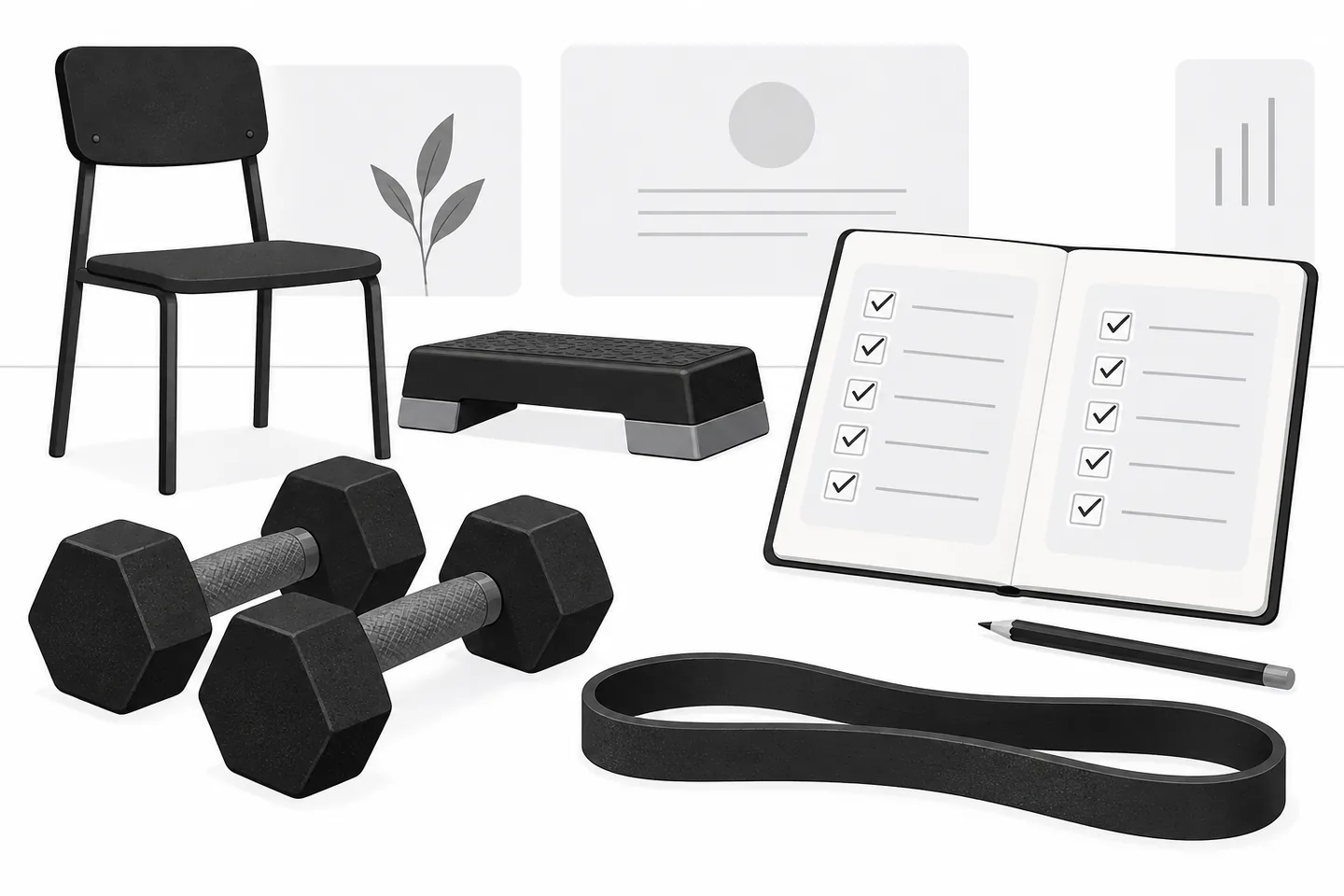
Choose two days with time to recover between them, such as Monday and Thursday. Do Session A on the first day and Session B on the second, then repeat that pattern the following week. Each session includes work for your legs, hips, back, chest, shoulders, arms and trunk. This follows the CDC’s guidance to strengthen the major muscle groups on at least two days each week. You can use bodyweight, a resistance band, weights or gym machines; choose versions you can set up and control.
Set up your first week
Begin each session with a few minutes of easy movement, such as walking, followed by an unweighted rehearsal of the first exercise. Start with one set per movement. A set is one round of repetitions. Aim for 8–12 controlled repetitions, or 8–12 on each side when the exercise alternates sides. The CDC describes 8–12 repetitions as one set and says you can begin with one set. If the movements remain controlled and the session feels manageable, try two sets when you next do that session.
Rest between sets until you feel ready to repeat the movement with the same control. Use a resistance that lets you finish without holding your breath or forcing the last repetition. For your log, rate the effort of the final set from 1 to 10: 1 means very easy and 10 means you could not complete another sound repetition. A score near 6 or 7 is a useful starting guide for this routine, not a target you must reach. If a movement feels awkward, reduce its range, use the easier option or leave it out until you can get guidance.
Session A: squat, hinge, push and pull
Work through these movements in order. Keep the same exercise versions for a few weeks so that your notes show whether they are becoming more comfortable. For movements done on each side, complete the stated repetitions on both sides before the next exercise.
- Chair squat: Sit back to a stable chair, touch it lightly and stand. Do 8–12 repetitions. Use the chair for balance as needed. In a gym, a leg-press machine is an alternative for leg work.
- Hip hinge: With a soft bend in your knees, move your hips back and then stand tall. Do 8–12 repetitions without weight first. Keep the range small while you learn the movement; there is no need to reach the floor. Later, hold light dumbbells if the unweighted version feels controlled.
- Row: Pull your hands towards your ribs for 8–12 repetitions. Use a band fixed to a secure anchor, a supported dumbbell row or a seated-row machine. Check that the anchor cannot slip before you pull.
- Incline push-up: Put your hands on a sturdy wall or fixed bench and press away for 8–12 repetitions. A higher surface usually makes this version easier. A chest-press machine is another option.
- Shoulder press: Press light dumbbells from shoulder height for 8–12 repetitions without leaning back. A band or shoulder-press machine can serve the same place in the session.
- Dead bug: Lie on your back, extend one arm and the opposite leg slowly, then switch sides. Do 8–12 repetitions on each side. Move only one limb at a time if that helps you keep your trunk steady.
The squat and hinge ask the legs and hips to work in different ways. The row, push-up and press cover pulling and pushing; the dead bug provides a controlled trunk movement. If six exercises feel like too much at first, do fewer repetitions within a comfortable range and record what you managed. Keep the order, rather than hurrying to finish every number.
Session B: step, bridge, push and pull
Use the same starting dose as Session A: one set while learning, then two when you can repeat the movements consistently. Session B changes the leg and trunk movements while retaining a push and a pull. Check any step or band anchor before you begin.
- Supported step-up: Step onto a low, stable step and return to the floor. Do 8–12 repetitions on each side, holding a rail if needed. If a suitable step is unavailable, use a supported split squat with a small range of motion.
- Glute bridge: Lie on your back with bent knees, lift your hips, pause briefly and lower. Do 8–12 repetitions. Start without added weight and keep both feet planted.
- Band pulldown: Pull a securely anchored overhead band towards your upper chest for 8–12 repetitions. Use a lat-pulldown machine or repeat the Session A row if you cannot secure a band overhead.
- Floor press: Lying on your back, press light weights upwards for 8–12 repetitions. A chest-press machine or the Session A wall push-up is a suitable alternative.
- Shoulder press: Repeat your Session A choice for 8–12 repetitions. Keeping the setup familiar makes it easier to compare how it feels across the two days.
- Bird dog: From hands and knees, extend one arm and the opposite leg, then change sides. Do 8–12 repetitions on each side. Move one limb at a time or put your hands on a sturdy raised surface if that is easier to control.
Do not use an unstable step or an anchor you do not trust. Replace that exercise with its listed alternative. A chair, wall and safe floor space cover much of the routine; bands and machines offer other ways to perform the same movement types. ACSM’s position-stand infographic includes bodyweight, bands and home-based exercise among resistance-training options.
Keep a short log and make one change at a time
After each exercise, record its version, sets, repetitions and the effort of the last set. Add a note if balance, setup or discomfort affected the work. Write “chair squat, 10 and 10, effort 6” if you completed two sets of ten. For a one-sided movement, write “step-up, 8 each side, effort 7”. These entries describe the work you did; they are not goals for the next visit.
At the next session, first ask whether the movement felt controlled. If it did, you might repeat exactly the same work or add one repetition per set. When you can do the upper end of the range with control and some room to spare, you could make the exercise slightly harder and return to fewer repetitions. For a chair squat, that might mean holding a light weight while keeping the same chair. For an incline push-up, it might mean using a slightly lower, still stable surface. Change only one part of an exercise at a time so you can judge the effect.
Suppose your first chair squat entry is two sets of ten at effort 6. The following week you manage eleven in each set with the same chair and control. Later, twelve in each set still feels comfortable. You could then try a small increase in difficulty and return to ten repetitions. Meanwhile, a step-up that feels demanding at eight per side can stay at eight. That is a useful decision too: repeating a sound movement is part of practice. These are illustrative choices, not a timetable for improvement.
If a session is missed, resume with the next planned session and the last version you performed comfortably. There is no need to double the work to make up for a missed day. Two workable days are enough for this plan; a third day is optional. Walking or other aerobic activity can sit alongside these sessions, according to your own circumstances.
Know when to adjust or get advice
Stop a movement that causes pain instead of finishing the set for the sake of the log. If pain persists, or you are unsure about safe technique, seek individual guidance from a health care professional or qualified exercise specialist. If you have a chronic health condition or disability, the CDC recommends individual advice about suitable types and amounts of activity. A general routine cannot account for your symptoms, history or equipment. Keep your notes brief enough to use: what you did, how it felt and the one decision you will carry into the next session.